top of page

Subscribe to the blog

Join my email list and never miss a blogpost.

Also get access to specials deals exclusive to my subscribers.

Thanks for subscribing!

The Blog

  • Writer: Andy Walker
    Andy Walker
  • Oct 22, 2021
  • 3 min read

I don’t know about you, but I love watching Youtube videos. There are so many great artists out there, putting up videos for free and helping you and I to learn how to paint, or simply to enjoy watching them paint.

There are also some channels that are not so great. I personally don’t like videos that spend the first ten minutes talking about what they had for breakfast, or walking endlessly in search of a spot to paint. I like it when they get straight to the action. Perhaps I am just impatient, but I just want to see someone painting and teaching me something I didn’t know before. I want to get better, faster, as Chris Fornataro says.

Talking of which, he is the first on my list of six. This list is by no means the end of the story, but I want to introduce you to each one of them because they are my go-to favourite channels. Perhaps I can help you to home in on what I think are the best of the best. They are in no particular order – all of them are good! Some paint in oils, some in gouache, some en plein air, and some are helpful in whatever medium you work in. I hope you find them useful. Click on their names to go to their YouTube channels.

Chris Fornataro – The Paint Coach

Fast talking oil painter Chris Fornataro covers a multitude of techniques and ideas in these information packed videos. If you want to learn the basics of oil painting then you couldn’t do better than to start here.

Ian Roberts – Mastering Composition

I first came across Ian Roberts when I bought his book Mastering Composition about 7 or 8 years ago. Then last year I found his YouTube channel and immediately subscribed. His insights about composition and structure, tone and colour are so very helpful, and he uploads a video about once a week. These has helped me to rethink the way I paint. He is very easy to listen to and watch, and there is no waffle!
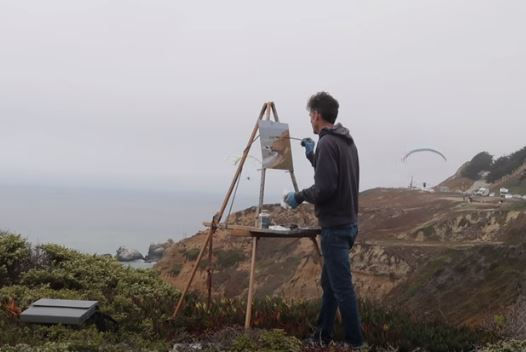
Michael Chamberlain

If you like watching people paint en plein air, then Michael Chamberlain is really worth a go. He lives near San Francisco and often paints the coastline or cityscapes in oils, and he is just easy to watch. You learn without realising you are learning. At times he does throw in a short section of surfing or eating burritos, but his videos are usually pithy and to the point. He makes me want to get the plein air kit and head outside!

Lena Rivo

Lena Rivo paints gorgeous gouache, acrylic and oil paintings, sometimes en plein air and sometimes in the studio. Usually there is no commentary, but I just like watching her paint and I love the end product. She is just very good at what she does.

James Gurney

If you have not yet come across James Gurney, then where have you been? He is the master of plein air gouache and casein painting. His videos are entertaining, informative and he is a master of the sketchbook. He can paint anything and make it look great – even the dullest of scenes become stunning in his hands. Look out for his creative opening title sequences!

Philip Mould – Art in Isolation

This one is just for the fun of it. Philip Mould is an art dealer in London and a presenter on the TV programme Fake or Fortune where they find out if unknown paintings are in fact masterpieces. During lockdown he started to produce a series of YouTube videos about the paintings he has in his house, which may sound dull until you see them and hear his explanations about how they came to be painted and the stories behind them. He understands great art. He understands the why’s and how’s and who’s of painting. A joy to watch, to marvel at, and to be inspired by some of the great artists of the past. Delightful and charming. Relax, sit back and enjoy.

Please use the comments box here to let us know who are your favourite art YouTubers.

Andy Walker

And finally, I have my own YouTube channel. Maybe not as grand as some of these others, but I’d love you to subscribe to it and see what I’m up to!

  • Writer: Andy Walker
    Andy Walker
  • Oct 15, 2021
  • 2 min read

Last year I bought and read the book “Spring Cannot be Cancelled” by David Hockney and Martin Gayford. It is a wonderful and easy read and is largely conversations and thoughts about painting and art in general. David Hockney was locked down in his farmhouse in France during the Covid outbreak and spent his time drawing and painting there (much of it on an iPad). The book is gentle, humorous, and full of insights and thought-provoking ideas about what art is and how to do it. I kept thinking – “Wow, I never saw it that way before!”

One thing that I had never thought about was the way that you can use a painting to tell a story through time. You can use it to lead the viewer on a journey, either through a landscape or through time. This is exactly what happens in the Bayeux Tapestry that depicts the events leading up to the Norman conquest of England.

Martin Gayford writes, ‘It is a picture that is almost seventy metres long and half a metre high (and more than nine hundred years old) that lacks what he (Hockney) has long yearned to escape: those neat edges that confine the conventional rectangular picture frame. He points out that at the bottom is the ground, the top is the sky, and, as you walk along from one end to the other, two years of time pass.

He also says that ‘it has a different relationship to space and time. There is no fixed point for a single linear perspective to recede towards, no frozen moment. Instead, it flows backwards and forwards from England to Normandy, across the sea and through the unfolding events from 1064 to 1066.’ Now that to me is a great piece of art!

David Hockney created a similar, but much smaller, time travelling drawing of his gardens in France. He used just a few colours and plenty of dots and stripes to convey his message in a sketchbook consisting of a single sheet of paper that opens out like a concertina.

‘Hockney’s panoramic concertina drawings of his garden are smaller in scope, both in territory and time, but they include several acres of ground spreading to all points of the compass, and the length in seconds, minutes, or hours that it takes to look hard at all that.’

A journey through time

When I read this my artistic world suddenly opened up. I had always thought of paintings being a moment frozen in time – a bit like the creative version of a photograph. Here is the landscape as I saw it, here is a still life as it was. There is no sense of time, apart from the one moment captured in paint. But now here was the possibility of creating art that took you on a journey through time. I thought I would have a go. So I made myself a little concertina book and took a small selection of coloured brush pens, and went outside to take a trek down the garden path. Here’s a short video showing you how it worked out.


If you’re inspired, then why not give it a go!

  • Writer: Andy Walker
    Andy Walker
  • Oct 8, 2021
  • 2 min read

I am falling in love with gouache paint. That may sound like a strange thing to say, but I think it’s true! Over the years I have painted in acrylics, oils and watercolour, and each in their turn have their positives and negatives.

Acrylics dry fast, which can be a good or a bad thing (good in a wet country like the UK, and bad where I now live in the dry heat of Spain). They also darken quite a bit as they dry and I have found this a little awkward, with paintings turning out darker than I imagined. Oils on the other hand dry very slowly, which I don’t really mind. I use water mixable oils which dry a bit faster than traditional oils, but you still need to wait several weeks before varnishing and framing. However their colour and tone do not change when they dry – what you paint is what you get. Watercolours produce a wonderful transparent glow and can have great accidental and unplanned effects. But the technique of using them is difficult and you need to plan well before putting brush to paper.

So this is where gouache paints come in. For someone like me who paints more instinctively than thoughtfully, who dashes in with a brush rather than preparing carefully beforehand, these paints are like magic! Because they are opaque you can cover over anything that you have already painted, and you can paint light over dark as well as dark over light. You can paint thin transparent passages and also flat opaque areas, thereby giving your paintings more interest. They have many of the advantages of oils without the slow drying time. So what drawbacks are there to gouache paints? I would suggest that they are not good for large paintings – I use them in my sketchbook, as their quick drying time makes them perfect for plein air. I am going to experiment with larger paintings by gradually increasing in size to see how far I can go, but I am assuming that over a certain size they will become too expensive to use. But that’s where oils can take over.

I have found that gouache is great for sketching outdoors, and I recently went out to film myself doing this. Take a look if you would like to here – its on YouTube: https://youtu.be/djZCz1cpJ8M

If you are interested to find out more about painting in gouache, In the early part of this year I wrote a course for beginners in gouache which you can find here:


Painting and sketching – ideas, inspiration and practical help to improve your art.

Follow

  • Instagram
  • Facebook
  • Youtube

©2035 by Daniel Tenant. Powered and secured by Wix

bottom of page